Pre-Surgery ACL Rehabilitation Guidelines and Exercises
Successful recovery from a torn ACL begins earlier reconstruction surgery. Long-term ACL enquiry conspicuously shows the stronger and more functional your injured knee joint earlier surgery, the further ahead you'll exist in your rehabilitation after.
What you lot do earlier surgery is referred to as prehabilitation or just prehab. The MOON Articulatio genus Grouping recommended prehabilitation exercises on this page will:
Strengthen your muscles
Increase your range of move
Increase blood flow around your knee to promote healing.
Pre-ACL Surgery Goals
The two most critical goals before and after ACL surgery are to:
Piece of work toward being able to fully straighten (attain full extension) of your injured leg
Walk normally
Other pre-surgery goals are to:
Minimize pain
Reduce swelling
Develop good quadriceps control and strength
The exercises on this page will assist you work toward these goals. These exercises are also used in the Phase one rehabilitation program that begins immediately following surgery. (See this chart for which exercises are recommended in prehab through Stage 3.)
Testify-Based ACL Rehabilitation
The bear witness-based MOON Knee Group anterior cruciate ligament post-surgery rehabilitation plan has five phases plus prehabilitation. Each has specific goals, exercises and instructions based on two decades of enquiry.
Success depends on completing each stage earlier moving on to the side by side. Your physician, physical therapist or able-bodied trainer will measure your progress and instruct yous on when to advance.
ACL Prehabilitation Guidelines
If you've torn your ACL, it is normal to experience discomfort, swelling and bruising. Hither are ways to manage the discomfort and swelling to prepare your human knee for surgery.
Crutch Use
You lot may be asked to walk with ii crutches. Crutches help you protect your knee and get around safely.
When using crutches, identify as much of your trunk weight on your leg as you can without increasing knee pain while walking. You might hear this chosen weight-bearing as tolerated or WBAT.
Your physical therapist or dr. will guide you on using crutches before and after surgery.
Ice, Elevate and Residuum
If you've torn your ACL, the recommendation is to ice, elevate and residue your genu to control swelling, inflammation and pain.
For at to the lowest degree the offset 24 hours after your injury or until severe inflammation is controlled, ice and elevate your leg at a level in a higher place your eye while lying down.
Elevate and back up your unabridged leg. Do non place a pillow or other back up under your knee alone.
If your medical professionals recommend compression, please ask them for specific instructions for utilize in your recovery.
Regain Mobility and Strength
The recommended exercises include ones to improve your mobility and ones to improve strength. Doing at least the main exercises in both areas is important for successful rehabilitation.
Primary, Alternating and Optional Exercises
If you've injured your ACL, yous might not feel similar moving your knee. However, keeping human knee motion and working toward total leg extension (straightness) are important in preparing for surgery and successful recovery after.
The MOON Articulatio genus Group ACL rehabilitation exercises are designed to move yous step by step. Exercises are identified as primary, alternate and optional.
Primaryexercises are the minimum recommended for achieving a successful recovery.
Alternateexercises achieve the same objective as primary exercises. Use these if your body is uncomfortable in the primary exercise position.
Optionalexercises provide additional forcefulness and conditioning.
Consult with your medical team near which exercises are advisable for you, especially if y'all experience increased pain and swelling.
Pre-Surgery ACL Mobility Exercises
Gaining total knee extension (straightness) is a disquisitional goal earlier surgery and in Phase i.
Principal Everyday Genu Extensions
When resting, sitting or lying down, extend your surgical leg in forepart of yous.
Straighten your leg as much as you can with your genu direct up.
Allow gravity to gently continue to straighten your knee.
Do this for twenty-30 minutes 3 to four times a twenty-four hour period.
Besides every 24-hour interval: perform the supine or decumbent knee extensions below before and subsequently your heel slide mobility exercises.
PRIMARY Supine (on Back) Human knee Extensions
Prevarication on your back with your genu direct.
Place a small towel whorl nether your heel (not your knee) and agree that position for 20-30 minutes three to iv times each twenty-four hours.
ALTERNATE Decumbent (on Stomach) Human knee ExtensionS
Lie on your tum with a pocket-sized apartment towel roll just above your articulatio genus on the thigh.
Let your foot hang off the end of the bed or table for 20 -thirty minutes iii to iv times each day.
Alternate Seated Passive-Assisted Knee ExtensionS
Seated in a chair place the human foot of your nonoperative leg under the knee surgery leg behind the foot.
Gently use your practiced leg to lift your surgical leg out equally straight as possible while keeping your surgical leg relaxed.
Return to the starting position.
Repeat 10–20 times ii to three times each mean solar day.
Principal Heel Slides—Genu Flexion and Extension
Lie on your back or sit and curve the knee joint ensuring the foot stays in contact with the floor or surface.
Slide the pes to straighten the knee to keep information technology mobile and try to better your range of motion.
Slight discomfort may be felt but stop if there is pain.
Repeat 10 to twenty times. Repeat the set three to four times a day.
PRIMARY Ankle Pumps
Prevarication or sit with your legs out straight with a towel curlicue under your ankle.
Bring your toes up and and so back down like y'all're lifting on and off a gas pedal.
Complete xv repetitions every hour.
Pre-Surgery ACL Mobility Exercises
Pre-Surgery ACL Force Exercises
Primary Quadriceps Set
The Quadriceps Prepare is vital in restoring your quadriceps force. It is too the foundation for many other exercises as you progress. Focus on correct muscle activation (tense and and so relax) and technique.
Offset on your back or sitting with your legs out direct.
Next tighten the top of your thigh so you lot are pushing your knee flat against the surface. This tightening should cause your human knee cap to motility toward your hip.
Focus on the quadriceps, not your gluteal (butt) muscle or hamstrings. If yous feel those engaging, interruption, reset and refocus on contracting the quadriceps.
Hold the muscle tight for five seconds.
Complete 12 repetitions, 3 times per day.
Hamstring Sets
You take four hamstring muscles along the dorsum of each thigh. These help control the knee with many activities including walking and stairs. Restoring hamstring force is just equally important as it is for the quadriceps on the front end of your thigh. These 2 hamstring sets help ameliorate muscle activation on the back of your thigh.
Primary Hamstring Prepare While on Your Back
Prevarication on your back and bend your articulatio genus to bring your calf to xc degrees.
Push your heel down into the surface with mild to moderate pressure.
Concord for six seconds, and so relax.
Perform 12 repetitions one to 3 times per solar day.
Alternate Hamstring Attack Your Stomach
Lie on your stomach with a towel under the front lower role of your thigh.
Bend your knee joint to bring your calf up to 90 degrees from the table or floor.
Perform 12 of these, ane to 3 times per day.
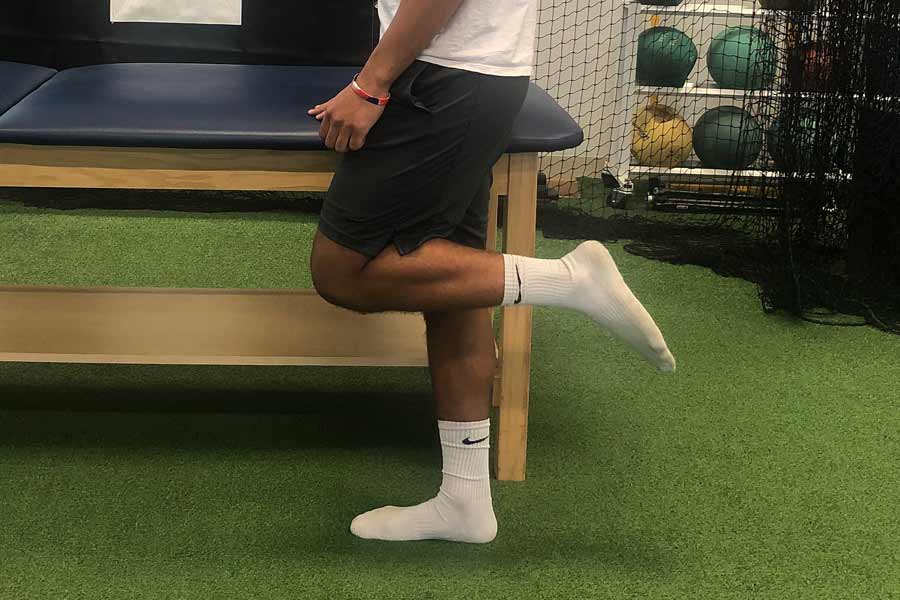
ALTERNATE Hamstring Prepare Standing
Stand on both feet with both crutches.
While supported by the crutches, perform a gentle hamstring curl, bending your knee upwards behind you.
Hold for six seconds, and then relax.
Perform 12 of these, one to 3 times per solar day.
Main Hamstring/Quadriceps Co-Contraction
Hamstring and quadriceps co-contraction will assistance activate (tense and so relax) both these muscles together. This is important for walking, taking stairs, continuing upwards and sitting down.
Prevarication on your back with your operative leg out straight. (Y'all may curve your nonoperative leg up to 90 degrees for comfort.)
Push your heel downward into the table like you're trying to "dig." Once you have these muscles contracting, tighten your quadriceps muscle by trying to straighten your leg.Push firmly only not so hard y'all elevator your body off the tabular array.
Hold this contraction of both sides of the thigh for v seconds, so relax.
Complete this do 12 times iii times per twenty-four hours.
Main Directly leg raises (Avoiding quad lag)
Straight leg raises (SLR) permit you continue to develop quadricep strength and part for return to walking and daily activities. Begin these after you've fabricated progress with quadriceps sets and can perform a direct leg raise. It will be a principal practise in your postoperative rehabilitation.
Focus on working the correct muscles.
Prevarication on your back with your nonoperative leg bent to 90 degrees.
Push button the knee of your operative leg apartment against the surface to tighten the top of the thigh.
Hold the thigh muscle tight. Lift your leg until your knee reaches the height of your other knee. Use a tiresome and controlled motion.
Proceed your knee joint as straight every bit possible to prevent "Quad Lag." Lag is when your knee bends slightly as you start to elevator your leg.
Focus on using the quadriceps muscles and NOT your hip. Concur the muscle tight during the entire movement.
Keep your human knee in line with your shoulder. This volition direct more than of the forcefulness toward your quadriceps muscle.
Return your leg to the surface slowly. Relax and and then retighten the muscle and perform some other repetition.
Complete 12 repetitions three times per day.
Main Prone Straight Leg Raises
Prone straight leg raises strengthen your hip and gluteal muscles. This will help with daily activities. Perform this practise lying on your breadbasket.
Prevarication on your tum with your legs near shoulder-width apart.
Tighten your core intestinal and gluteal muscles.
Lift just your operative leg off the table. Go on the muscles in your other leg as relaxed as possible.
If y'all find increased effort in your nonoperative leg, move it further from your torso. This will increase the load on your operative leg.
Lift your leg as far as y'all tin can and agree for two seconds.
Slowly lower your leg.
Practise Non rotate your hips or arch your back.
Complete this exercise 12 times three times a mean solar day.
If you lot find increased lower back pain, identify a pillow under your abdomen. This helps reduce back stress and better gluteal muscle use. Remove the pillow one time you lot go stronger.
Alternate Standing Hip Extensions
Standing hip extensions increment your ability to bear weight on your operative leg while walking. They as well strengthen muscles around your hip.
Stand tall with your easily on a stable surface for support.
Shift your weight onto your nonoperative leg.
Maintain an upright position. Lift the non-stance leg slightly and move it back. Exercise non let your pelvis and body rotate.
Concur for ii seconds and and then slowly return to the starting position.
Complete this exercise 12 times on each leg iii times per day.
Add a resistance band as your strength improves with the approving of your doc, physical therapist or athletic trainer.
Do this exercise with a smooth and controlled movement.
Alternate Prone Hamstring Curls
Perform decumbent hamstring curls on your tummy for strengthening and to improve range of motion (the ability to bend your human knee).
Lie on your breadbasket. You may want a towel roll or pillow under your thigh for condolement when moving your knee.
Bend your operative knee to move your heel upward toward your back. Perform this motion slowly and deliberately.
Agree this bent-knee position for five seconds.
Slowly lower the foot back down to the table slowly (over two to three seconds).
Perform 12 repetitions three times per day.
Main Double-Leg Heel Raises (calf printing)
Heel raises better calf forcefulness. This will help yous walk and, after in your rehabilitation, jump and run.
Stand with your hands on a table or other stable surface for support.
Place your feet shoulder-width apart.
Keep your weight the same on both legs.
Go on your toes on the ground and lift your heels using a two-second count.
Concur this position for a brusk period, then lower slowly for four 2d
Complete the exercises 12 times one to iii times per day.
Make sure your motility is vertical. Do not rock forrad or use your artillery to elevator you.
OPTIONAL Standing Hamstring curls
Once y'all are comfortable performing prone hamstring curls and can acquit weight (stand) on your operative leg with control, standing hamstring curls can improve hamstring force.
Stand with your easily on a stable surface for support.
Maintain an upright position. Shift your weight slightly to the uninjured leg. Attempt not to lean.
Bend your knee of your other leg to bring your heel up toward your back.
Hold for 5 seconds.
Slowly lower to the starting position.
Complete sets of 12 times i to 3 times a mean solar day.
It is important to feel the muscles working in the back of your thigh. Your trunk might try to compensate past moving the hip up. Limit this by keeping the correct starting position and following the instructions.
Master Double-Leg Quarter Squats
Double-leg quarter squats provide an important transition to strengthen further your quadriceps, gluteal muscles and hamstrings. They also enable yous to amend weight-bearing movements through your knees.
There are multiple important steps to this exercise. Avoid having non-targeted muscles perform the workload (called compensation). This volition assistance you achieve your goals more than efficiently.
Stand with your feet shoulder-width apart
Place your hands on your waist.
Bend slightly at your hips, then at your knees.
Lower your buttocks downwards about six inches as if you were going to sit in a chair.
Straighten your legs and hips to return to standing.
Proceed your weight evenly on both legs. Avoid shifting weight to the nonoperative side.
Go on your trunk straight and limit any tilt forward. Aim to keep the middle role of your knees over your 2nd and third toes without letting your knees become forward across your toes.
You might find information technology useful to exercise these squats in front end of a mirror. This will show y'all whether yous're keeping weight evenly on each leg.
PRIMARY Side-Lying Hip Abduction
Side-lying hip abductions amend musculus force in the side and the back of your hip. This helps you walk. Follow the instructions and cues carefully to better exercise effectiveness.
Lie on your nonoperative side.
Straighten your top (operative) leg and keep information technology straight throughout the practice.
Bend your lesser leg knee and hip in a comfortable position.
Your first few times doing this practise, consider placing two to three pillows between your knees at the starting position. This takes stress off the side of the hip. Once y'all're stronger, you volition no longer need the pillows.
Important: bring the top leg slightly behind your trunk with your toes rotated in slightly. This further activates the muscle on the side of your hip.
Lift your elevation leg using your hip, not your back or side.
Lower your leg.
Keep the hips aligned. Do not let your trunk rotate back.
Complete this exercise 12 times one to three times per day.
OPTIONAL Side-Lying Hip Adduction
Side-lying hip adduction increases strength on the within of your leg and improves function. It requires a practiced starting position.
Circumspection: If y'all have had an MCL injury or repair, do this practise only with the approval of your surgeon and concrete therapist.
Lie on your side with your operative leg down.
Extend your operative leg out direct.
Pull the foot of your nonoperative leg toward you lot and place it downwardly in front of your operative knee.
Continue your body and hips stable.
Elevator your extended operative leg off the tabular array. Keep information technology up and straight for two seconds.
Slowly lower the operative leg downwardly to the table.
Complete this exercise 12 times 3 times per twenty-four hours or to your physical therapist's recommendation.



0 Response to "How Good Are Acl Repair Surgery"
Post a Comment